
Six answer engine optimization tools, compared by the job they actually do
AEO software spans technical SEO, prompt monitoring, citation research, enterprise workflows, and controlled benchmarks. Choose the measurement model before comparing feature lists.
How this comparison was produced
Documentation review, not a fabricated hands-on ranking
100 Questions publishes this page and has direct product evidence only for its own benchmark. Competitor descriptions below come from the linked first-party product and help pages, checked on August 10, 2026. No vendor paid for inclusion, and the order is not a best-to-worst ranking.
- The product has a current first-party page documenting an AI visibility, answer-engine, citation, or prompt-measurement workflow.
- Its measurement model represents a distinct buying job: fixed benchmarking, recurring monitoring, broad research, integrated SEO, or enterprise operations.
- The comparison can describe a concrete best fit and limitation without relying on affiliate commissions, undisclosed access, or invented scores.
At-a-glance matrix
Compare workflow before comparing features
These categories summarize the documented measurement model. Confirm current provider coverage, limits, pricing, and evidence access directly with each vendor before purchasing.
| Tool | Primary workflow | Cadence | Documented evidence |
|---|---|---|---|
| 100 Questions | Frozen evidence-linked benchmark | Point-in-time baseline and like-for-like rerun | Stored answers, source URLs, coverage, PDF, and CSV exports |
| Ahrefs Brand Radar | Large-scale AI visibility research inside an SEO suite | Index research plus configurable prompt tracking | Brand, citation, source, and share-of-voice analysis |
| Semrush AI Visibility Toolkit | AI visibility research connected to wider SEO workflows | Recurring research and monitoring | Prompt, competitor, source, and visibility analysis |
| Profound | Enterprise answer-engine analytics and operations | Ongoing multi-team program | Citation, answer-engine, content, and agent analytics |
| Otterly.AI | Focused scheduled AI search monitoring | Recurring prompt checks | Visibility, citation, and supported-platform tracking |
| Peec AI | AI search analytics and brand monitoring | Recurring prompt and source analysis | Visibility, position, sentiment, sources, and competitors |
The comparison
Match the tool to the decision
100 Questions
Fixed evidence-linked benchmark
Best for
Baselines, client deliverables, and identical before-and-after reruns without a subscription.
Measurement
One frozen 25-question set across OpenAI, Claude, Gemini, and Grok, with web grounding and stored answer evidence.
Tradeoff to verify
Point-in-time benchmarking rather than continuous monitoring; Perplexity is not included.
Public methodologyAhrefs Brand Radar
Large-scale visibility research
Best for
Teams combining AI visibility research with an established SEO and backlink workflow.
Measurement
Search-backed prompt indexes and custom prompt tracking with brand, citation, and share-of-voice analysis.
Tradeoff to verify
Broad research depth can be more than a small team needs for a single controlled baseline.
Ahrefs documentationSemrush AI Visibility Toolkit
Integrated SEO and AI visibility suite
Best for
Marketing teams that want AI answer research inside a wider SEO, content, and competitor platform.
Measurement
AI visibility, prompt research, competitor tracking, source analysis, and adjacent SEO workflows.
Tradeoff to verify
The broader suite model differs from a frozen, evidence-linked benchmark.
Semrush documentationProfound
Enterprise AI visibility platform
Best for
Larger organizations coordinating AI visibility research, content, and reporting across teams.
Measurement
Answer-engine insights, citation analysis, agent analytics, and enterprise workflow features.
Tradeoff to verify
Designed for a broader enterprise program rather than a lightweight one-off audit.
Profound featuresOtterly.AI
Focused prompt monitoring
Best for
Teams that want a straightforward recurring view of brand mentions and citations across selected AI searches.
Measurement
Scheduled AI search monitoring across supported platforms with visibility and citation tracking.
Tradeoff to verify
Monitoring a changing prompt program answers a different question than repeating one frozen benchmark.
Otterly documentationPeec AI
AI search analytics and monitoring
Best for
Growth and marketing teams that want recurring prompt, source, and competitor visibility reporting.
Measurement
Brand visibility, position, sentiment, source, and competitor analysis across AI answer platforms.
Tradeoff to verify
A subscription monitoring workflow may be unnecessary for an occasional baseline or client audit.
Peec AI product page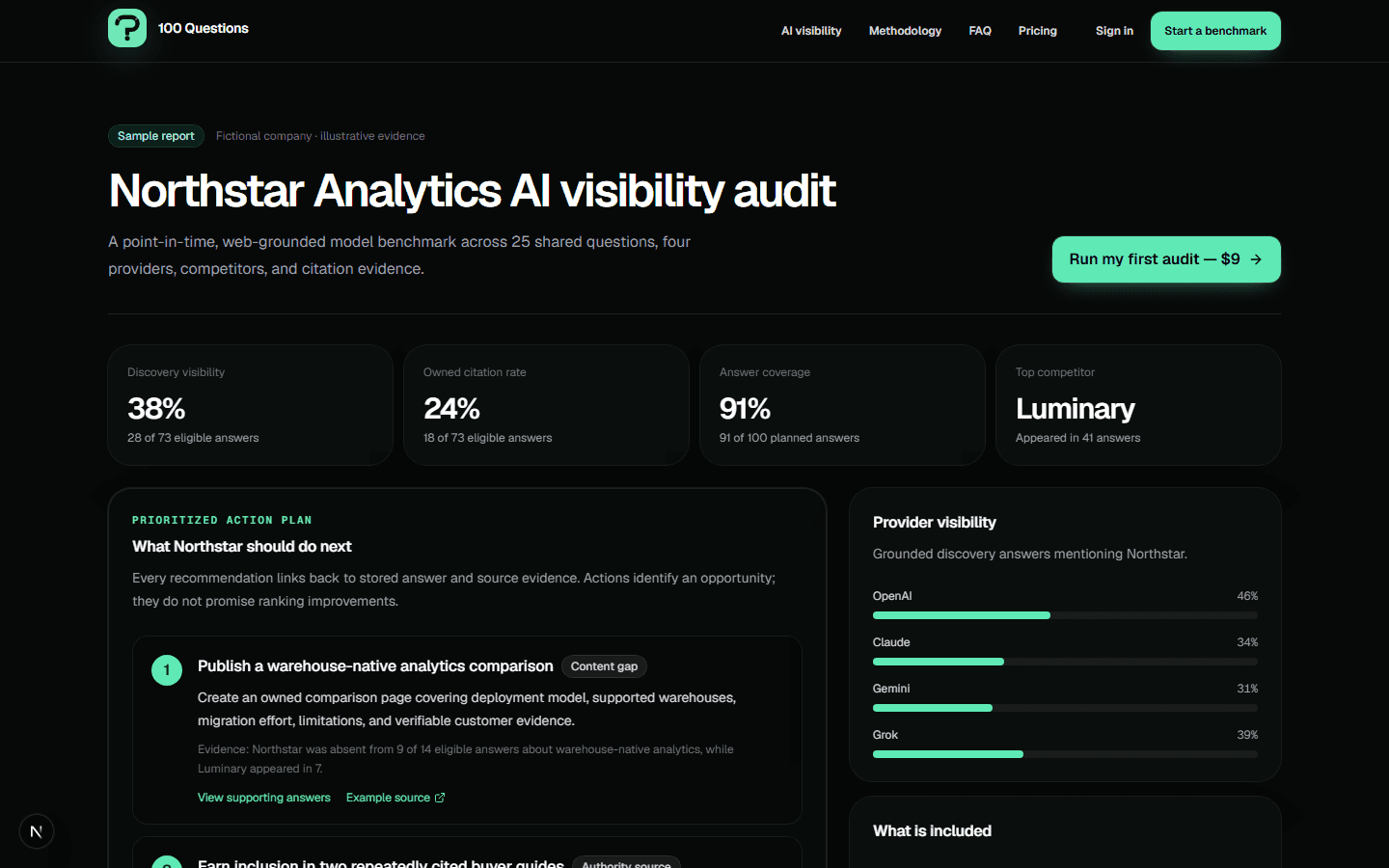
First-hand evidence boundary
Inspect our output; verify every competitor at its source
The public sample shows the report format 100 Questions can substantiate directly. For the other five tools, this page links to vendor documentation and deliberately avoids unsupported performance scores or claims of hands-on access.
Buying checklist
Six questions to ask before buying an AEO tool
Do we need a snapshot or a trend?
Use a frozen benchmark for a defensible baseline. Use monitoring when weekly or monthly movement is the decision.
Can we inspect the evidence?
Require access to the answer, prompt, provider, timestamp, cited URLs, and exclusion reason behind each metric.
Are prompts stable enough to compare?
A changing prompt panel helps discovery research; a frozen set is stronger for before-and-after claims.
Which providers matter?
Confirm the product covers the assistants your buyers use and disclose whether results come from APIs, consumer interfaces, or search indexes.
Does the tool include technical SEO?
AI answer measurement does not replace crawl, indexation, internal linking, schema, or backlink analysis.
What happens after the score?
Prefer tools that expose missed questions, recurring sources, competitors, and page-level actions instead of one opaque number.
Tools are only the measurement layer
AEO still depends on crawlability, answers, evidence, and authority
Software can reveal where a brand is absent, which competitors appear, and which sources recur. It cannot substitute for technically accessible pages, direct answers to buyer questions, consistent entity facts, original evidence, and trustworthy third-party corroboration.
Use the AEO implementation guide for the work itself, the free technical checker for access signals, the AI visibility tools hub for the full tool map, and the best AI visibility tools comparison for adjacent SEO suites, or the focused guide to the best Peec AI alternatives.
Selection questions
Answer engine optimization tools FAQ
What are the best AEO tools in 2026?
The best AEO tool depends on the workflow: 100 Questions for a fixed evidence-linked benchmark, Ahrefs Brand Radar for large-scale visibility research, Semrush for combined SEO and AI visibility work, Profound for enterprise answer-engine operations, Otterly.AI for daily prompt monitoring, and Peec AI for ongoing visibility tracking. Compare the measurement model and evidence access before feature counts.
What is an answer engine optimization tool?
An answer engine optimization tool helps a team understand or improve how its brand and content appear in AI-generated answers. Different tools handle different jobs: technical SEO, prompt monitoring, citation research, content workflows, or controlled visibility benchmarks.
What should an AEO tool measure?
At minimum, useful answer-level measurement should separate brand mentions, prominence, competitor share of voice, citations, sentiment, and provider coverage. The underlying questions, answers, sources, timestamps, and exclusions should remain inspectable.
Is an AEO tool different from an AI SEO tool?
The categories overlap. AEO tools focus on inclusion and citation inside generated answers. AI SEO tools may also cover technical audits, keyword research, content optimization, backlinks, and conventional search performance.
Can AEO software guarantee citations in AI answers?
No. Tools can reveal access problems, content gaps, recurring sources, and visibility changes, but providers control retrieval and answer composition. Any guaranteed placement claim should be treated skeptically.
Should a small team buy continuous AEO monitoring?
Only if it will act on frequent trend data. A fixed benchmark can be more economical for a baseline, a client report, or an occasional rerun; recurring monitoring is more useful when a team owns an ongoing AI-search program.
Related paths
Continue the AI visibility workflow
Measure cross-model visibility
Run 25 buyer questions across four providers with answer and citation evidence.
Decide between AEO, GEO, and SEO
Compare the surfaces, inputs, metrics, and reporting jobs before naming the program.
Free AI visibility checker
Test crawl access, page signals, schema, and sitemap discovery.
Choose an AI visibility tool category
Route from readiness checks and templates to benchmarks, trackers, and enterprise suites.
When you are ready to compare actual answers across four AI providers, review the frozen 100-answer benchmark.
Need a controlled baseline?
Freeze the questions and keep the evidence.
Product coverage changes. Review each linked first-party source before making a purchase decision.