
AI search visibility tool for mentions, citations, and share of voice
See where AI overlooks your brand, which competitors appear instead, and which sources shape the answer. One frozen benchmark produces 100 planned answers and keeps the evidence attached.
First-purchase price. No subscription. Results are directional and do not guarantee future placement.
- 25 buyer questions
- Four web-grounded providers
- Competitor comparison
- Answer and citation evidence
- Five prioritized actions
- PDF and CSV exports
What the report separates
One score cannot explain why a brand is missing
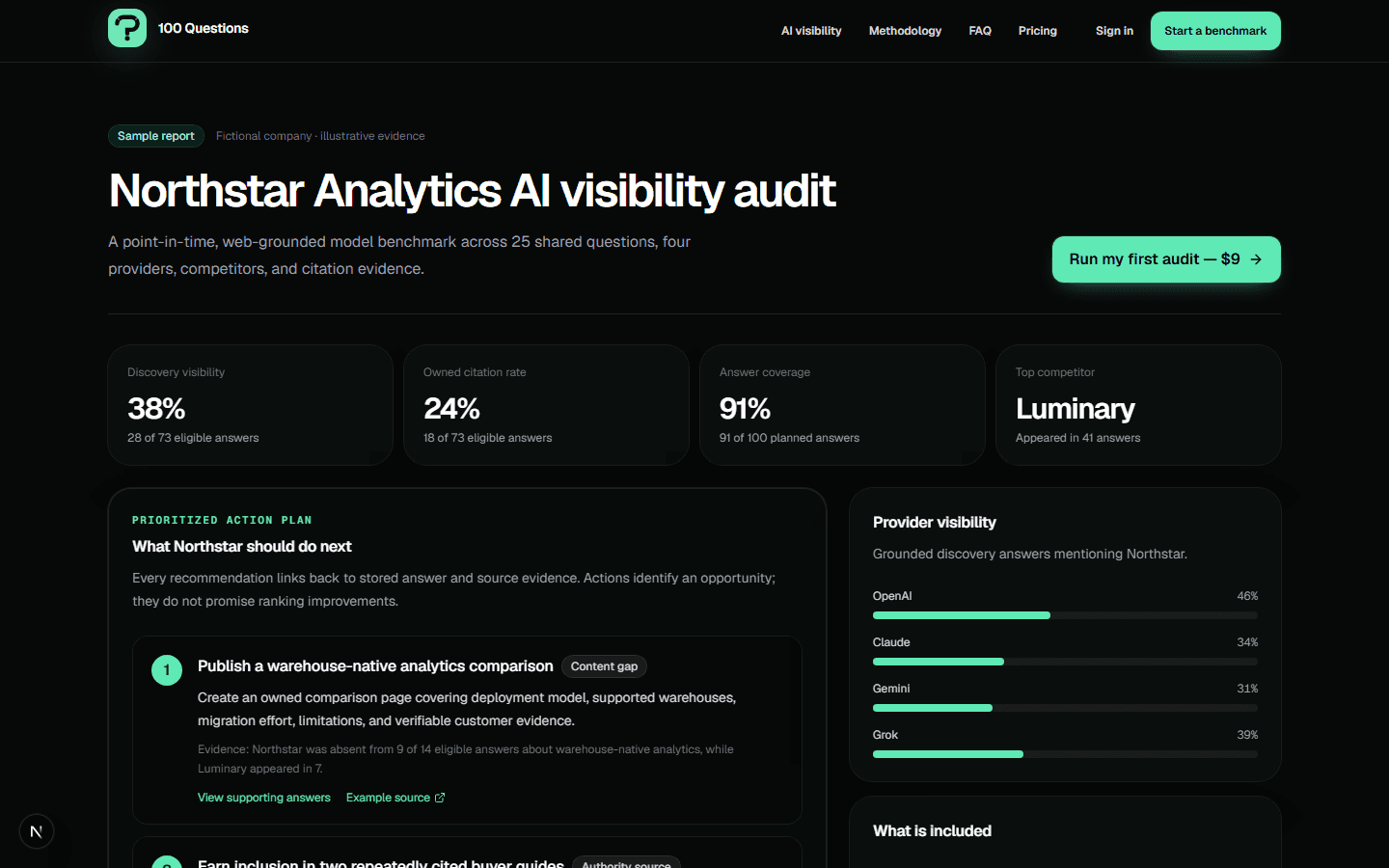
The illustrative values below show how a report keeps mentions, citations, competitor share of voice, and provider coverage distinct. Every result links back to the stored question, answer, and sources.
Mentions
28 / 80
Illustrative neutral discovery answers that name the brand.
Owned citations
12 / 80
Illustrative eligible answers citing the claimed domain.
Share of voice
31%
Illustrative target mentions divided by tracked brand mentions.
Coverage
94 / 100
Illustrative planned answers that finished with usable evidence.
The 25 × 4 method
One question set, four grounded provider views
- 01
Freeze 25 buyer questions
Use 20 neutral discovery questions and five brand-named diagnostics. Lock the wording, market, competitors, and collection conditions.
- 02
Send the same set to four providers
OpenAI, Claude, Gemini, and Grok each receive the identical questions through model APIs with web grounding.
- 03
Preserve up to 100 answer records
Store the answer text, source URLs, brand mentions, prominence, competitor evidence, timestamp, model identifier, and eligibility status.
- 04
Turn gaps into five actions
Connect missed buyer questions, recurring competitors, and cited-source patterns to technical, content, or authority work.
Tool vs manual prompt testing
Automate the audit trail, not the judgment
| Decision factor | Manual prompt test | 100 Questions benchmark |
|---|---|---|
| Cost | Free except for team time | $9 first audit; no subscription |
| Collection | Copy prompts and answers by hand | 25 frozen questions sent through one shared four-provider harness |
| Evidence | Only as complete as the worksheet | Answers, sources, models, timestamps, failures, and eligibility stored together |
| Scoring | Build and maintain formulas manually | Mentions, prominence, share of voice, citations, sentiment, and coverage |
| Best use | A small exploratory spot check | A client-ready baseline or comparable before-and-after rerun |
Prefer a manual workflow? Use the free ChatGPT brand visibility test and prompt-tracking spreadsheet. The measurement definitions are public either way.
Frozen benchmark, not rank tracking
Repeat the same test after meaningful work
Permanent rank tracking implies one stable position. AI answers are composed from changing model, prompt, source, market, and time conditions. 100 Questions freezes the test so the conditions are inspectable.
Use the first audit as a directional baseline. Ship a meaningful technical, content, or authority change, allow time for recrawling, then rerun the identical questions. Compare the stored evidence—not just two composite scores.
Choose the right model
Best for a bounded audit, not an always-on dashboard
Use 100 Questions for
- A point-in-time baseline before an AI visibility project
- A client-ready audit with inspectable answer and citation evidence
- A like-for-like rerun after meaningful technical, content, or authority work
Choose continuous tracking when
- It is not continuous monitoring and does not send daily alerts.
- It does not currently test Perplexity or reproduce consumer chat interfaces.
- It is a directional 25-question sample, not a statistically representative market ranking.
Build a defensible benchmark
Understand every input before you buy
AEO vs GEO
Choose the optimization lens and the metric that belongs to it.
How to measure AI visibility
Set the protocol, denominators, metrics, and rerun rules.
AI visibility score
Calculate a transparent score without hiding the component rates.
Mentions vs citations
Separate being named in an answer from being used as a source.
Choose buyer questions
Build a balanced question set around real buying decisions.
AI Overviews vs cross-model
Choose single-surface tracking or a four-provider benchmark.
Before you run an audit
AI search visibility tool questions
What is an AI search visibility tool?
An AI search visibility tool measures whether and how a brand appears when AI systems answer relevant questions. Useful tools preserve the questions, provider conditions, answers, sources, competitors, and failures behind each metric instead of reporting an unexplained score.
Which AI models does 100 Questions test?
Each audit sends the same 25-question set to OpenAI, Claude, Gemini, and Grok through model APIs with web grounding, creating 100 planned answers. It does not currently test Perplexity or reproduce personalized consumer chat interfaces.
Is this an AI rank tracker?
No. It is a frozen, point-in-time benchmark designed for a baseline and comparable reruns after meaningful work. Choose a continuous tracker when you need daily or weekly prompts, alerts, trend lines, or always-on multi-project reporting.
How much does the AI visibility audit cost?
The introductory first audit costs $9. The normal single-audit price after the first purchase is $15, with prepaid three- and ten-audit packages. There is no subscription, and credits remain valid for 12 months.
Can I see an AI visibility report before buying?
Yes. The complete sample report is public and requires no account. It shows the question set, provider coverage, mentions, citations, competitors, share of voice, limitations, stored evidence, and five prioritized actions.
Does the tool guarantee future AI mentions or citations?
No. Results are a time-stamped, directional API-grounded sample. Answers vary by provider, model, search results, prompt, market, and time, so the benchmark cannot guarantee a future mention, citation, recommendation, or ranking.
One prepaid benchmark
Find the buyer questions where AI overlooks your brand.
Run 25 frozen questions across four grounded providers and keep the evidence behind every result.