
Planting the brand in discovery prompts
A brand-named question tests recognition or accuracy. It cannot prove that a neutral buyer would discover the brand.
Build a controlled benchmark around real buyer questions, preserve the answer-level evidence, and keep visibility, citations, competitors, accuracy, and coverage distinct.
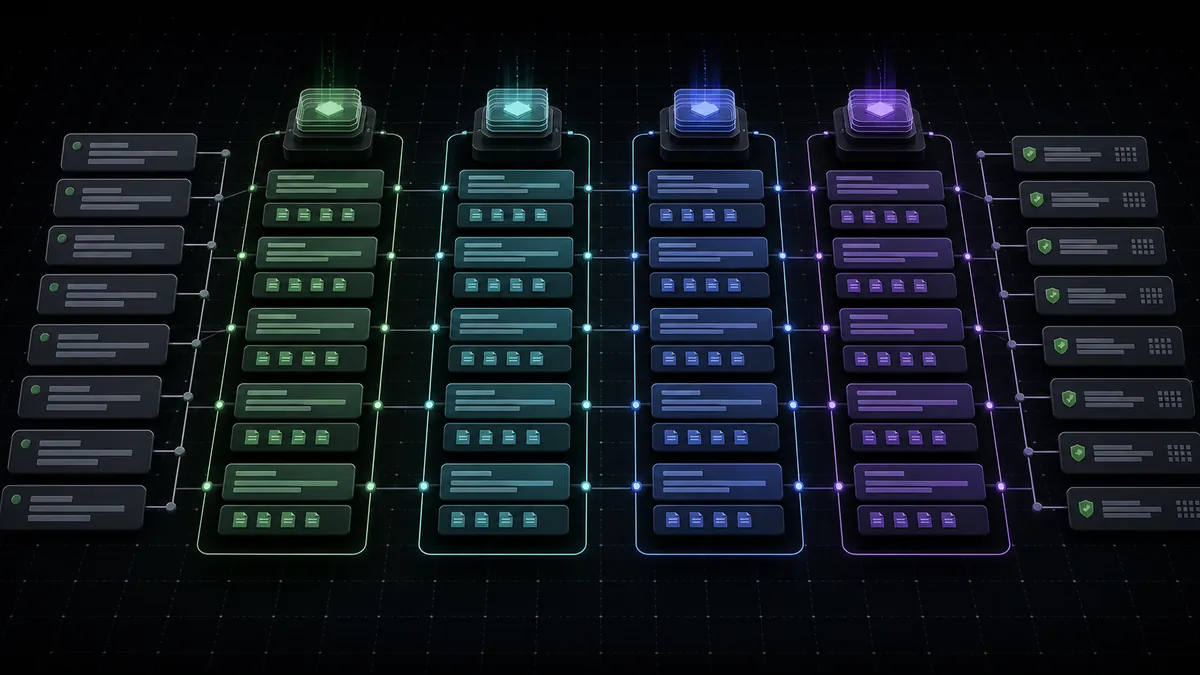
Start with the measured surface
AI search visibility measures whether a brand appears, how prominently it appears, and which sources support the answer when an AI system responds to relevant questions. A technical readiness check can show that a site is accessible; it cannot prove that a provider actually mentioned the brand.
Define whether the program is measuring answer-level AEO, broader cross-engine GEO, or both. The AEO vs GEO comparison maps each surface to the right metrics.
Seven-step protocol
Write down the category, audience, use cases, constraints, country, language, target brand, claimed domain, and selected competitors.
Cover category discovery, use-case fit, comparisons, risk, and proof. Keep neutral discovery questions separate from brand-named diagnostics.
Record provider, model identifier, web-grounding requirement, locale, collection date, and any exclusion rules.
Preserve the exact question, full answer, source URLs, timestamp, target and competitor mentions, prominence, and completion state.
Exclude failed or unsupported answers from relevant visibility denominators and report them transparently in coverage.
Report mentions, prominence, share of voice, citations, accuracy, and coverage before considering a composite score.
After meaningful work and recrawling time, reuse the same questions and conditions. Compare the underlying answers and sources, not only the headline score.
Metric dictionary
| Measure | Transparent formula | Decision it supports |
|---|---|---|
| Discovery visibility | Neutral eligible answers mentioning the target ÷ neutral eligible answers | Can buyers discover the brand before naming it? |
| Prominence | Lead or shortlist mentions ÷ answers that mention the target | When present, is the brand central or incidental? |
| Share of voice | Target mention events ÷ target plus selected-competitor mention events | Who occupies the shortlist across the same questions? |
| Owned citation rate | Eligible answers citing the claimed domain ÷ eligible answers | Does the brand's site supply source evidence? |
| Accuracy | Accurate brand descriptions ÷ target-named answers | Is the brand represented correctly after it is named? |
| Coverage | Eligible grounded answers ÷ planned answers | How much of the benchmark produced usable evidence? |
Common measurement errors
A brand-named question tests recognition or accuracy. It cannot prove that a neutral buyer would discover the brand.
A grounded answer can cite third-party pages without citing the target domain. Store domains and classify ownership explicitly.
Collection failures depress visibility for reasons unrelated to the brand. Put them in coverage.
A different question set, model, market, grounding rule, or formula changes the measured object.
Evidence notes
The formulas here are transparent product methodology, not an industry standard. Preserve the raw questions, answers, sources, model identifiers, failures, and collection date with every result. Sources reviewed August 20, 2026.
Run the controlled version
The AI search visibility tool preserves 100 planned answers, citations, competitors, coverage, and five prioritized actions.
Contextual next steps
Use the next resource that matches the decision at hand: define the program, inspect the method, or collect a comparable cross-provider baseline.
Run a frozen 25-question benchmark across four providers and inspect the underlying answer evidence.
02Map answer selection, brand understanding, SEO, and cross-model measurement to the right program.
03Preserve provider conditions, answers, citations, competitors, and comparable reruns.
Common questions
There is no single best metric. Start with discovery mention rate, then keep prominence, competitor share of voice, claimed-domain citations, factual accuracy, and provider coverage separate. Each metric diagnoses a different problem.
Enough to cover meaningful buyer decisions without pretending to be statistically representative. A balanced 20-question neutral discovery set plus five brand diagnostics is practical for a directional benchmark. Record the limits and compare only identical reruns.
No. A provider failure or answer that does not meet required grounding conditions belongs in coverage. Counting it as a brand miss confuses collection reliability with brand visibility and biases the result.
Only when the question set, providers, market, collection date, grounding rules, eligibility criteria, and formula match. Similar-looking scores from different protocols are not necessarily comparable.
Apply this resource
Preserve the questions, conditions, answers, citations, and failures so the next decision rests on inspectable evidence.